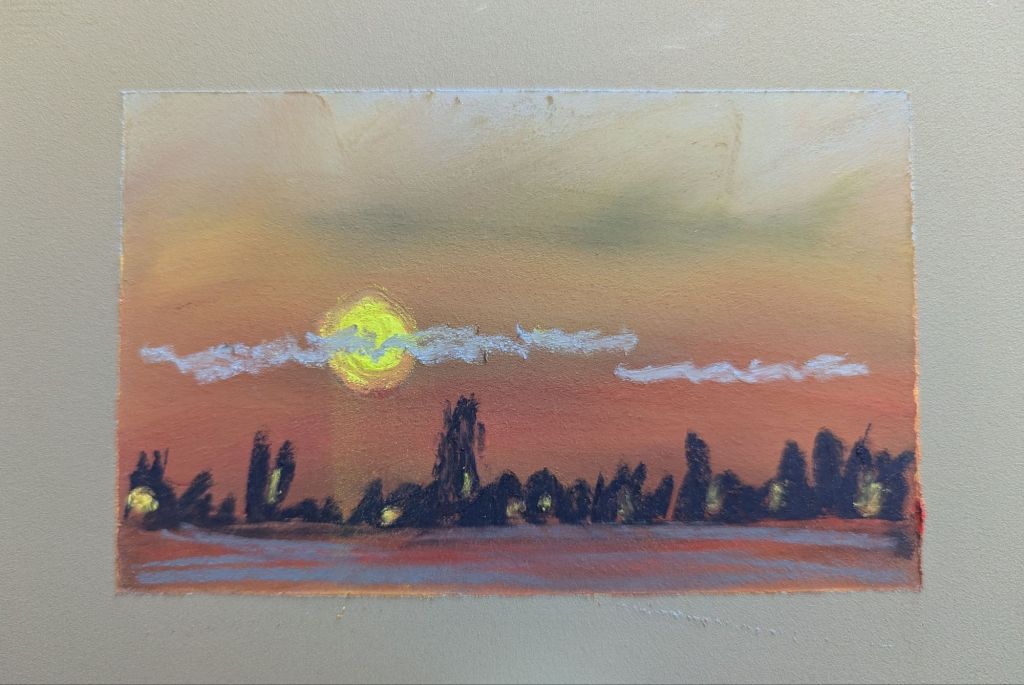
“Skyline Sunset” soft pastel on Pastelmat, 7″ x 9.5″, 2026
This piece was inspired by a quiet moment looking over a quantity of sunset images in various urban areas that were shared with me (or taken by me) over recent years. Rather than a copy of any one of those, this piece seeks to capture a certain quality of cities and sunrises.
This piece was painted using Blue Earth, Sennelier, and Henri Roche pastels, and is available for sale.
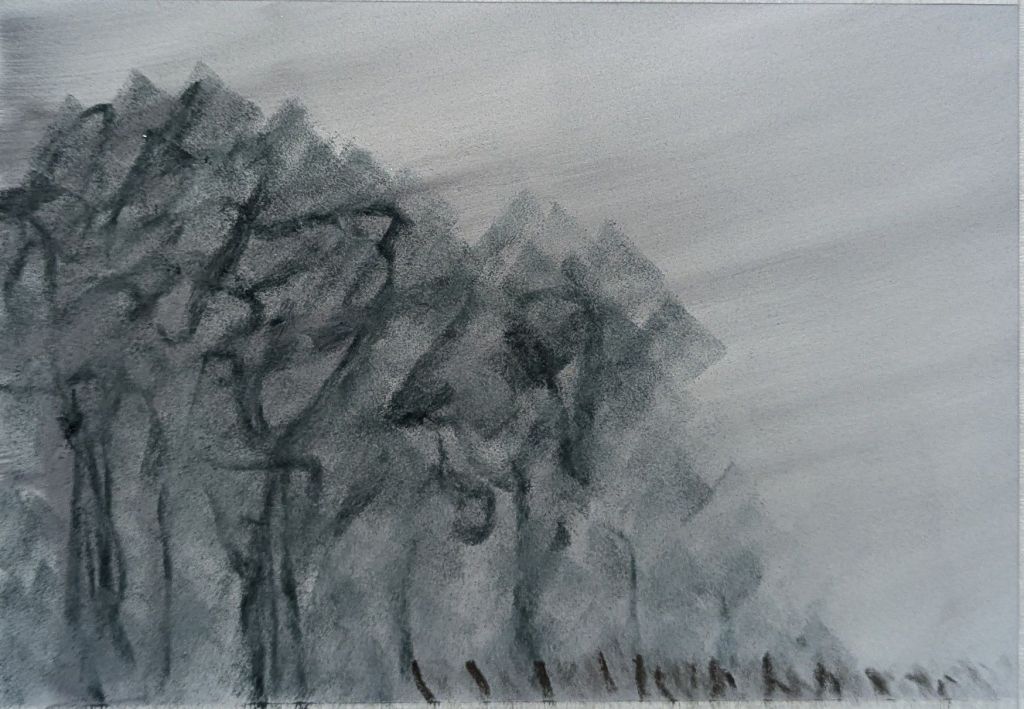
“Oaks in the Mist” pastel on Pastelmat, 2026, 7″ x 9.5″
This piece was inspired by a misty morning hike down an oak lined trail. This piece was done using Blue Earth pastels, listening to Downliners Sekt (an old album, “Statement of Purpose”).
I enjoy a beautiful sunrise. Happily, there are so many!
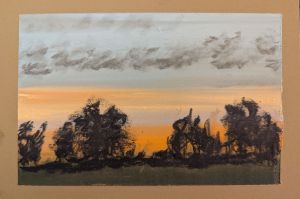
“Summer Sunrise, McMinnville, June 2026″ – 5″ x 7”, pastel on pastelbord
This June sunrise is done on Ampersand Pastelbord, using Blue Earth soft pastels. It captures the western horizon on a colorful morning, seen from a local trail.
This piece is available for sale. If interested, please contact me by email.
I chose my first soft pastels with care, but also with limited experience (and I’m still quite new to pastels as I write this). I’ll admit, too, that one detail important for me personally was not related to the look or feel of using the pastels, nor to do with the pastels themselves, directly; the history of the brand. The legacy. The way they have withstood the test of time, and the other artists who have used them. No surprise, then, that two French brands stood out for me, and ended up being early choices for me in this medium, eh? Sennelier and Henri Roché.
Sennelier has been around awhile, too, and is a definite “workhorse” of a soft pastel brand that many many artists of note have used. There’s a sense of continuity in using them, beyond their good general quality. They’re also pretty commonly available at art supply stores.
I like both of these brands, not only for their history, but also for how they feel, and the look of them on the page. The colors have good durability, and lay down well. They feel soft and smooth in my hand without falling apart easily, with some specific pigments in each brand having some variance (sometimes a bit gritty, other times a tad dusty, and it seems more to do with the specific pigments being used and less about either brand generally). I love the colors.
One thing about both these brands, though, is that they’re made in France. By itself this isn’t a problem at all, it just comes with a catch; it’s not always easy to find or obtain some specific individual color quickly, and I’m not always looking for a set. There are occasions when I’m not willing to sacrifice inspiration in the moment to wait on a package to arrive. These can be costly, too (and let’s be frank, the Henri Roché pastels are the Lambo of soft pastels – they have the price to prove it – and everything else that seems “expensive” is quite reasonable by comparison). I’m not really giving price much thought, here, I’m just making a point to identify this as a potential concern for most artists.
I do want to talk about how these compare to an American brand of very similar reputed quality. I’m trying this brand for the first time; Blue Earth pastels. There’s not much history here (made since 2012), so “legacy” details aren’t a factor, but I’d heard they’re very good quality and couldn’t find a direct comparison between the Henri Roché pastels and these. I’ll be comparing these three brands for my own benefit, and deciding whether to continue to use all three, or pare things down to two favorites over time (it’s a personal preference; I don’t prefer to have a wild random assortment of different brands in the medium I use). There don’t seem to be many comparisons of these brands to each other, so I’m sharing my thoughts.
I’m hoping to make a decision which brand will form the foundation of my palette long-term, versus being relegated mostly to accents, highlights, fun stuff, and specific projects or unique colors. (I did say I’m not focused on price, but… I’m also not made out of money. lol)
Here’s what I’ll be comparing:
Color characteristics
How they feel in my fingers
How they lay down on the surface I’m using
How much dust they make in regular use
How easily they smudge and blend
How much I enjoy using them in general (which is quite subjective but matters most to me personally)
Shall we get started?
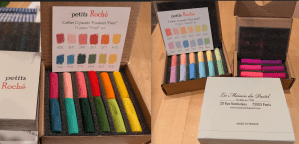
This is my current selection of Henri Roché pastels:
My Henri Roché pastels photographed in a state of chaos in my Roz Box (after a mishap resulted in spilling them to a tabletop).
I don’t have many of these; I buy them “as a treat” now and then or for a particular project that just wants that special something. There are currently 1958 available colors, total (wow!). I purchased these as small half-stick assortments, (and there are several really nice ones to choose from), and selected a small custom assortment of full size sticks in green hues which use pigments I favor (cobalt, chromium, and cadmium). I purchased them directly from the manufacturer’s website, but they are also available from a US vendor online, here.
Three half-stick assortments that got me started with Henri Roché.
Color characteristics – Color-wise, the Henri Roché soft pastels are amazing. Unmatched pigment saturation and there are so many beautiful hues to select from! I love the way each color has a selection of tints and shades from full saturation to the lightest most delicate tint. I never regret choosing colors from this brand.
How they feel in my fingers – The pigment is quite fine, and minimal binder is used in these. They aren’t “powdery”, nor are they “chalky”. They have a dry, firm, feel without being brittle in use. Some specific pigments seem slightly more “coarse”, with a somewhat rougher feel. I’d call these generally “fine”. They feel soft and smooth in my fingers. These are slim round sticks, well-crafted (by hand) with excellent consistency of shape and density.
How they lay down on the surface I’m using – These pastels lay down dense even color on the surfaces I prefer (usually pastelmat or pastelbord). They don’t tend to flake at all, and the dust produced isn’t excessive or super powdery. They adhere well to a surface.
How much dust they make in regular use – meh. “Normal dusty”? These pastels are very much my idea of… Ideal.
How easily they smudge and blend – these pastels smudge and blend well when approached with intention. I find that they don’t seem prone to “casual smudging” that can easily muddy a very colorful piece of work, which is nice.
How much I enjoy using them – truthfully, I love using these, and if it were a “cost no object” sort of world I’d have the complete set, and none other.
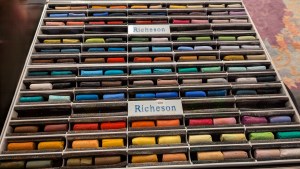
This is my current selection of Sennelier, (mostly purchased as a set):
My selection of Sennelier soft pastels, photographed in my Roz Box, rather randomly placed.
There are currently 525 shades listed available on their website. My original set was a set of half-sticks, but new colors have been purchased from their open stock full sticks. These are very easy to come by, and even the larger sets are quite affordable and available online and in local art stores. The paper wrappers on the full sticks are a pain in the ass to remove.
Color characteristics – these pastels have good saturation and and a good selection to choose from. They’re readily available in good sized sets with enough variety to really get started (which is how they ended up being my first pastels).
How they feel in my fingers – I’d call these “medium fine”. They have an amount of binder consistent with most professional brands of soft pastel, and feel dry and soft-ish in my fingers. They are more prone to flaking than the Henri Roché pastels. They don’t tend break in normal use. They are not particularly even in size or form (half sticks), and the wrappers are a serious annoyance (full size sticks). These are round sticks, and considering the volume they sell, it’s not a surprise that modern manufacturing techniques and machines are used to make them. They often have little air pockets here and there.
How they lay down on the surface I’m using – these pastels lay down a good bit of pigment but only as evenly as the stick itself is well-shaped. These benefit from some attention to the side or edge I plan to use before I proceed.
How much dust they make in regular use – these seem a bit less dusty than either the Henri Roché or the Blue Earth pastels. This probably has to do with the specific binders used and the relative coarseness of the pigment particle size. I’ve got to use quite a bit of pressure to create a lot of dust with these. They’re pretty easy to vacuum up or wipe from a tabletop.
How easily they smudge and blend – these smudge decently well without excessive muddying, but don’t blend as well as the Henri Roché pastels. This may be something to do with how various shades are created or the binders used. I started with these, though, and I’ve learned their ways. lol
How much I enjoy using them – these pastels are suitably pleasant to use. They’re sort of a “Honda Civic” (my opinion) – reliable, comfortable, conveniently available, but they aren’t an “effortless experience”, nor are they “luxurious”. I probably used the right phrase earlier; “workhorse”. I use them a lot, and often reach for them first when I set up the palette for an individual piece, and if not first, I end up grabbing one on the fly, in a moment of inspiration.
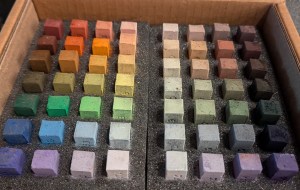
Here’s the new selection of Blue Earth pastels, to consider:
The newly arrived assortment of Blue Earth pastels, the Nomad 56 selection.
The “full set” of colors available on the website includes 336 colors, but does not include the 21 darks that are also available (so, 357 in the line, total, as of writing this). The individual sticks are square, with precise “sharp” edges when they arrive, very flat sides and about “half stick” sized. These have less availability, but are easy to order online, although several of the assortments are often on back order.
Color characteristics: the pigment seems pretty dense and concentrated, with a reasonable amount of binder (not too much, and they don’t end up seeming chalky at all).
How they feel in my fingers: The surface of these pastels is very silky smooth and soft. I’d call them “very fine”. These are quite square with good symmetry and very consistent shape. I don’t have any information about the specifics of how they are made.
How they lay down on the surface I’m using: These pastels lay down a relatively thick amount of pigment without much pressure, and blend nicely. There’s some flaking, not a lot, but this can drop occasional chunks of pastel in spots I didn’t expect (or want) it to be.
How much dust they make in regular use: I’d characterize these as relatively “dusty”, due to the very fine pigment. After doing a small “test piece”, I found little drifts of dust here and there out of sight that I didn’t expect when I was tidying up. If I were going to make these my primary pastels, I’d certainly want to consider using a mask or respirator, as it seems likely there’d be quite a bit of dust ending up in the air, too.
How easily they smudge and blend: these pastels smudge and blend very easily, that was definitely a fun part of using them. I also found that I reliably had to go back over several areas to add more pigment, as the process of blending and smudging also removed more than I anticipated.
How much I enjoy using them: these are very pleasant to use. I don’t personally care for the vertical storage of the box they come in for actual use; they’ll end up in my Roz Box, in a section of their own, or in some other case similarly set up for laying them out horizontally. They behave quite differently (in my hand) than the French pastels I’m more used to. Mixed feelings, for me, and I’m a bit undecided.
This comparison is more difficult than I expected, when I consider my goal of settling on a preferred brand for my pastels, generally. I find myself yearning to embrace Henri Roché with a “cost no object!” battle cry, and having to admit that may be unrealistic. I haven’t yet used the Blue Earth pastels enough to be certain whether I could ever replace the Sennelier pastels with those, although I find myself considering it because the manufacturing quality stick-by-stick is clearly better. I think I want to spend more time painting with them before I decide – but that’s the direction I’m leaning.
I give some thought, too, to making a decision from a “use case” perspective, meaning to say perhaps I could relegate the conveniently square, compact, Blue Earth pigments to an assortment intended specifically for travel or plein air painting, and tuck them into a French easel drawer with that in mind? They are quite lovely. I’ve quite a lot to think about.
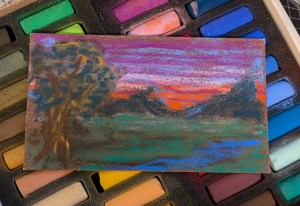
(My) first piece (ever) using the Sennelier soft pastels.
A similar piece using the Blue Earth soft pastels.
Hopefully putting my thoughts and observations into words is helpful for you in some way, as you consider your options from among the many choices of soft pastels available to you. Thanks for reading!
December 23, 2024 Update:
I’ve been continuing to paint with my combination of Henri Roche, Sennelier, and Blue Earth* pastels, and it seems like a good time to make an update. *The TL;dr is simply this – I don’t find find myself reaching for the Blue Earth pastels very often. Hardly at all, actually. It seems worth saying so.
I want to be very clear that art being what it is, some of the choices an artist makes are purely preference. There’s nothing “wrong with” the Blue Earth pastels at all. Great pigments, and they lay down well. They feel good in my fingers when I’m using them. I just don’t reach for them, even though they are right there in my Roz Box with my Sennelier pastels, conveniently within reach any time. I don’t choose them. Now and then I sort of “make myself use them”, and I’ve committed myself to going ahead and “using them up” to make room in my box for more Sennelier sticks, which I definitey reach for again and again (my HR pastels are in their own Roz Box). I’ll go out of my way to grab a particular Henri Roche color. I rely on my Sennelier pastels day-to-day. Somehow, for some reason, in my particular practice of pastel painting, I just don’t put the Blue Earth pastels to use very often.
I don’t have much insight to offer. It could be the shape? It could be the extra soft softness of using them. It could be the additional dust. I just don’t know. I don’t use them with the comfort and ease with which I use the Henri Roche and Sennelier pastels. It is what it is. They’re lovely, and some other artist may adore them – with good reason. That artist isn’t me.
I spent some hours recently thinking over which additional hues I want to add to my palette – and in every case those will be Henri Roche pastels. I’m not so fortunate as to be able to casually drop thousands of dollars on pastels (very few artists are), so the Sennelier pastels help fill in a lot of my palette with “day-to-day” hues. These are the pastels I use. I’m okay with that.